Keep scrolling, and a Comice pear tree will draw itself the way ours grew — slowly, crookedly, on purpose. It is seeded like anything worth keeping: reload, and a different tree grows. Always a pear. Never the same one.
Pyrus communis ‘Doyenné du Comice’ — raised 1849 in the garden of the Comice Horticole, Angers, France. The buttery one.
Scroll to grow
I · Year one — the whip
You don’t plant a pear. You graft one.
A pear seed is a gambler. Plant one and you get a wild stranger — thorny, sour, nothing like its mother. So every true Comice on earth is a graft: a cutting of a cutting of a cutting, one unbroken line of wood going back to a single tree in Angers, France, 1849. Our great-grandfather set his whips in Rogue Valley dirt a hundred years ago, give or take a war, and joined the lineage.
A whip is nursery talk for a first-year tree — one unbranched stem, all ambition and no shade. Every orchard begins as a field of held breath.
This tree is Graft № ····. Reload and the number changes; the pear does not. That is roughly how family works.
II · Years two to five — the scaffold
The shape you cut in winter is the crop you pick in fall.
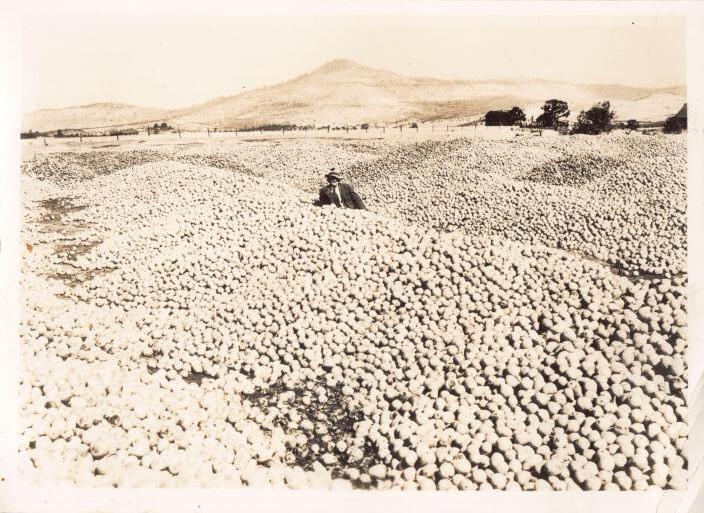
The first limbs are called scaffolds, and they carry everything that comes after — fruit, ladders, children. Grandpa’s law was three or four scaffolds, wide angles, nothing crossing, and no limb you couldn’t trust a kid on. By the 1930s the family rows ran toward the bald hill east of Medford, and at harvest the Comice came off in wagonloads.
Plate I — the harvest, c. 1930
The great-grandfather, sitting in that year’s harvest. He grew every pear in this photograph. The hill behind him grew nothing at all.
The Rogue Valley is one of the earth’s great pear places — deep bench soils, furnace summers, cold nights sliding off the Cascades. Medford shipped Comice east in iced railcars, and it is still the pear this valley mails across America every December.
III · Early April — bloom
No bees, no pears. Which is how a pear farm ends up named for a bee.
A pear blossom refuses its own pollen. Botanists say self-incompatible; we say it needs the neighbors. Every April the orchard held its breath — five white petals to a flower, five to seven flowers to a cluster — waiting on somebody with six legs to make the introductions.
The family secret: bees are lukewarm about pear nectar. It runs thin — low sugar, faint perfume — and a hive with options will drift to the mustard bloom instead. So an orchardist keeps his hives close and his rows tempting. Great-grandfather kept the pears. We keep the bees. Same handshake, other hand.
A pear flower’s nectar is roughly half as sweet as an apple’s — one more reason to be patient with bees, and to keep your own.
IV · Late September — harvest
A pear ripens in the dark, off the tree.
Comice is the buttery one — the pear that made fruit-of-the-month famous, so tender the packing houses wrap each one in tissue like it might bruise from a hard look. But here is the trick nobody tells you: leave a pear to ripen on the branch and it ripens from the inside out, mealy at the core before the skin admits a thing. You pick it hard. You lay it somewhere cool and dark. You wait.
When the flesh beside the stem gives to a gentle thumb, cancel your plans and eat it over the sink.
Check the neck, never the belly. Press lightly by the stem: if it yields, it’s ready. If you waited for the belly to soften, you’re two days late — and it knows.
V · Present day — one tree left
The orchard is smaller now. One tree, kept like a promise.
The rows came out over the decades — the valley grew houses better than pears, in the end — and the family went chasing other pollinations: a Navy commission, model airplanes, a human-powered helicopter pedaled inside a Boeing hangar in 1994. But one Comice still stands at the fence line, and every September it leans a little lower with fruit.
The honey, the mead, the pickles — all of it descends, one way or another, from this tree. We named the farm for a bee. The bee, if you ask her, worked for a pear.
A few will fall. They’re windfalls; they’re yours. Windfalls: 0
Windfall, n. — fruit the wind picks for you. The origin of our pickled-pear habit, and most of our better decisions.
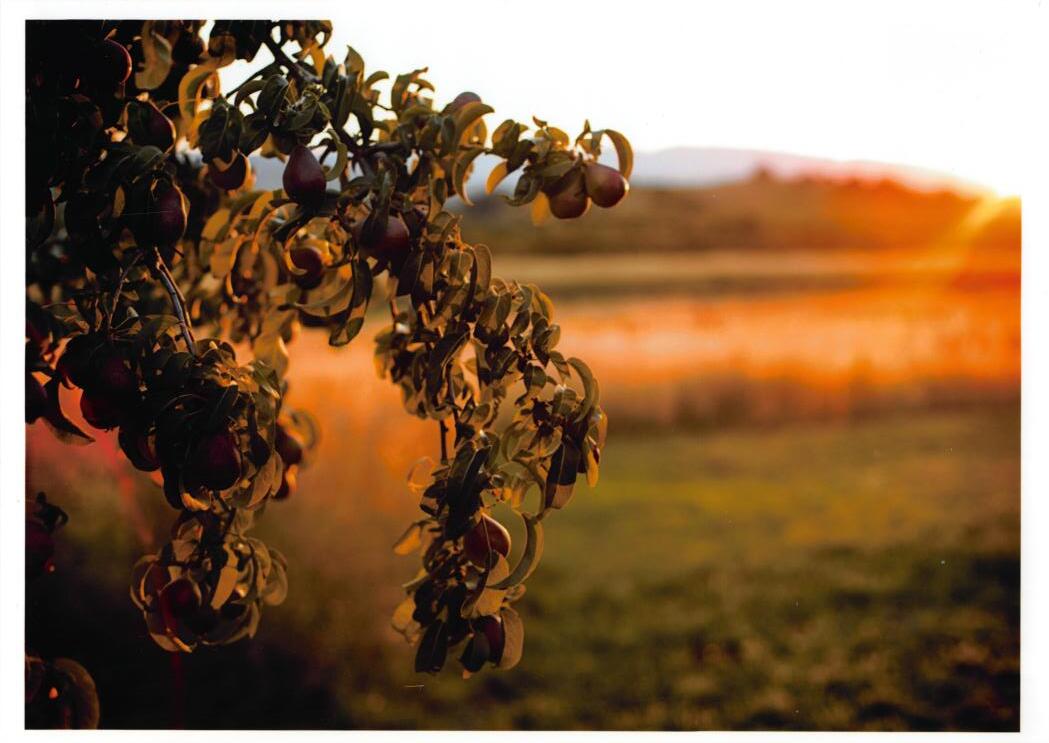
Plate II — the fence line, September
The last pear tree, golden hour.
Still setting fruit. Still refusing its own pollen. Still, somehow, the whole farm in one tree.
The bees it fed live at the Hive. The people who picked it are in the Lineage. What the kitchen does with windfalls is in the Cellar — and the flying machine, well. That’s the Arcade.